
Puja Sachdev | September 25, 2025 | Spousal Support

When negotiating a divorce settlement in San Diego, California, it is essential to understand the tax deductibility of spousal support payments. Tax considerations can have a significant impact on your strategy for a divorce settlement.
Generally, federal tax deductions for spousal support are based on when the order was entered. State tax rules vary depending on the state. Here’s more about what you need to know.
Tax Deductibility of Spousal Support Payments on Federal Tax Returns
Whether you can deduct spousal support or alimony payments from federal taxes depends on the date your divorce was granted. The Tax Cuts and Jobs Act (TCJA) changed federal tax law for deducting spousal support payments as of January 1, 2019.
For orders entered before January 1, 2019, the payer can deduct spousal support payments from their federal income taxes. The recipient must include spousal support payments as taxable income on their federal tax return.
If your spousal support order was entered on or after January 1, 2019, you cannot deduct alimony from your federal income taxes. Likewise, you do not need to report alimony payments as income on your federal tax returns.
Tax Deductibility of Spousal Support Payments in California
California continues to use pre-2019 tax rules for spousal support and alimony. Payments received must be reported as income, and payors can deduct them on state returns. Domestic partner support is treated the same, though federal tax law does not address it, so legal guidance may be necessary.
It’s important to adjust correctly between federal and state returns, since misclassifying payments—such as combining child support and alimony—can result in errors or penalties. Child support is never deductible or taxable. To ensure compliance with California’s dual system, consulting a tax professional and divorce lawyer is strongly recommended.
Is Spousal Support Mandatory in a Divorce in San Diego, CA?
California divorce laws give judges the discretion to award alimony or spousal support. However, the laws govern when spousal support can be awarded. If the spouses have a prenuptial or postnuptial agreement, the court generally recognizes the provisions for spousal support within the agreement.
However, the agreement must be legally binding and fair to all parties; otherwise, the court may disregard the agreement.
Spousal Support Without a Marital Agreement
When the parties do not have a marital agreement and have not negotiated a divorce settlement, the court looks to Family Code §4320 for guidance.
According to the California Family Code, judges must consider the following factors when deciding whether to grant spousal support:
- The length of the marriage
- The extent to which both parties have the earning capacity to maintain their current standard of living
- The supporting spouse’s ability to pay support payments
- The extent to which the supported spouse contributed to the training, education, or career of the paying spouse
- The value of the couple’s marital property
- Any evidence of domestic abuse
- The general health and age of both spouses
- The tax consequences of spousal support payments
- The ability of the spouse receiving support to engage in gainful employment
- The goal that the spouse receiving alimony achieves financial independence within a reasonable period
Judges weigh these factors together, which means spousal support decisions vary widely depending on each couple’s circumstances.
Duration of Spousal Support in California
The length of the marriage plays a key role in determining support duration:
- Short-term marriages (under 10 years): Support typically lasts no more than half the length of the marriage.
- Long-term marriages (10+ years): Support may continue for extended periods and, in some cases, indefinitely.
Support generally ends if the receiving spouse remarries or achieves financial independence.
Ask a San Diego Divorce Lawyer About Taxes and Spousal Support Payments in California
The issue of taxes and spousal support can be confusing in California divorce cases. If you have questions or need direction, contact San Diego Divorce Lawyers, APC at (619) 866-3756 for a complimentary case evaluation with a San Diego spousal support lawyer.
It is in your best interest to understand how tax laws can impact your divorce settlement before signing any documents with your spouse.
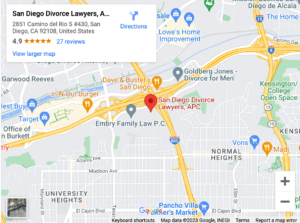
We proudly serve throughout San Diego County. We are located in San Diego, California.
San Diego Divorce Lawyers, APC
2851 Camino del Rio S #430
San Diego, CA 92108
(619) 866-3756