
Puja Sachdev | January 2, 2026 | Divorce

If you are going through a divorce, one of the first questions you may ask is: How long does a court take to finalize a divorce in San Diego, CA? The timeline can affect housing, finances, child custody, and emotional closure. While every case is different, California law sets minimum timeframes, and several factors can either shorten or extend the process.
Understanding how the divorce timeline works can help you set realistic expectations and avoid unnecessary delays.
California’s Mandatory Waiting Period
California has a mandatory waiting period for all divorces. This rule applies statewide, including San Diego County.
Under California law, a divorce cannot be finalized until at least six months have passed from the date the divorce papers are properly served on the other spouse. This six-month period is required even if both spouses agree on every issue.
This means that even the simplest divorce cannot be finalized in less than six months.
Uncontested Divorces and Typical Timelines
An uncontested divorce is one where both spouses agree on all major issues, including property division, child custody, child support, and spousal support.
In San Diego, an uncontested divorce often follows this general timeline:
- Divorce petition is filed and served
- Six-month waiting period begins
- Required financial disclosures are exchanged
- A written settlement agreement is submitted to the court
- The judge reviews and signs the final judgment
If all paperwork is completed correctly and there are no disputes, the divorce may be finalized shortly after the six-month waiting period ends. However, delays can still occur if documents are missing or incorrectly filed.
Contested Divorces Take Longer
A contested divorce takes longer because the spouses cannot agree on one or more issues. These cases require more court involvement and often include hearings or a trial.
Factors that can extend the timeline include:
- Disagreements over child custody or visitation
- Disputes about property or debt division
- Requests for spousal support
- Complex financial situations
- Allegations of hidden assets
Contested divorces in San Diego can take a year or more to resolve. Some cases may take several years if the issues are complex or heavily disputed.
How Child Custody Issues Affect Timing
Divorces involving children often take longer. California courts must focus on the best interests of the child, which can require additional steps.
Custody-related delays may involve:
- Court-ordered mediation
- Parenting plans and custody evaluations
- Temporary custody orders
- Hearings to resolve disputes
If parents cannot agree on custody terms, the court may require evaluations or additional hearings, which adds time to the process.
The Role of Court Scheduling in San Diego
San Diego family courts handle a large volume of cases. Court availability can affect how quickly hearings are scheduled and how long it takes to receive rulings.
Delays may happen due to:
- Limited court dates
- Backlogs in family court calendars
- Continuances requested by either party
Even when both sides are prepared, court scheduling can slow progress.
Paperwork Errors Can Cause Delays
Divorce cases are often delayed because of paperwork issues. Missing forms, incomplete disclosures, or filing errors can prevent a judge from finalizing the divorce.
Common paperwork problems include:
- Incomplete financial disclosure forms
- Missing proof of service
- Incorrect settlement language
- Failure to submit the required local forms
Careful preparation and review of documents can help avoid these delays.
Temporary Orders Do Not Finalize the Divorce
Many divorcing spouses receive temporary orders for custody, support, or property use early in the case. These orders help manage day-to-day issues but do not finalize the divorce.
Temporary orders remain in place until a final judgment is entered or replaced by permanent orders. Some people mistakenly believe their divorce is complete once temporary orders are issued, but that is not the case.
Can a Divorce Be Finalized Faster?
While the six-month waiting period cannot be shortened, some steps can help prevent unnecessary delays.
Steps that may help move a case along include:
- Responding to paperwork on time
- Completing financial disclosures promptly
- Being open to negotiation or mediation
- Avoiding unnecessary court disputes
These steps do not bypass the legal waiting period but can reduce delays after it ends.
Contact the San Diego Divorce Lawyers at San Diego Divorce Lawyers, APC for a Complimentary Case Evaluation
The length of time it takes to finalize a divorce in San Diego depends on the unique situation. At a minimum, the process takes six months. Uncontested cases may be finalized soon after that period ends. Contested divorces often take much longer, especially when custody or financial disputes are involved.
If you’re considering a divorce in San Diego, CA, and need help, San Diego Divorce Lawyers, APC is here for you. Our San Diego divorce attorneys can protect your rights and guide you through the process. Contact us today at (619) 866-3756 for a complimentary case evaluation.
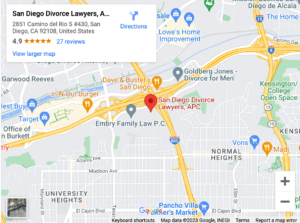
We proudly serve throughout San Diego County. We are located in San Diego, California.
San Diego Divorce Lawyers, APC
2851 Camino del Rio S #430
San Diego, CA 92108
(619) 866-3756