Puja Sachdev | February 19, 2026 | Divorce

When a quit-claim deed is signed during marriage, it can have lasting consequences that spouses may not fully anticipate. These documents are often treated as routine paperwork, particularly during refinancing, but they may significantly affect ownership rights between spouses.
Depending on state law and the circumstances, signing a quit-claim deed can later become a central issue in divorce or probate proceedings. For that reason, even seemingly simple title changes during marriage should be approached with caution.
What Is a Quit-Claim Deed?
A quit-claim deed is a legal document that transfers whatever ownership interest a person has in a property to another party. It does not guarantee that the signer actually owns the property or that the title is clear. Instead, it simply transfers any interest the signer may have at the time.
Because it provides no warranties or protections, a quit-claim deed is often used between spouses or family members. However, once signed and recorded, it can significantly affect property rights.
When Are Quit-Claim Deeds Used in Marriage?
During marriage, quit claim deeds are commonly used when one spouse refinances the marital home and a lender requires the other spouse to be removed from title.
Other situations involving quit claim deeds include:
- Adding or removing a spouse from the title for loan qualification
- Estate planning or asset protection strategies
- Informal agreements between spouses without legal advice
Many spouses sign these documents believing they are a formality with no long-term consequences.
Title vs. Character of Property in California
California is a community property state. As a general rule, property acquired during marriage is presumed to be community property, regardless of whose name appears on the title. This presumption cannot be overcome simply by changing the title.
A quit-claim deed signed during marriage does not automatically transform the community property character of real estate.
Why Quit Claim Deeds Are Often Misunderstood
Spouses frequently assume that signing a quit-claim deed means they have permanently given up all rights to the property.
In family law, that may not be true. Courts look beyond the document itself and examine:
- The intent of the parties at the time the deed was signed
- Whether the deed was part of a broader agreement
- Whether the signing spouse understood their rights
- Whether there was adequate disclosure and consideration
If a quit-claim deed was signed solely to facilitate refinancing, without clear intent to permanently change the community property into separate property, the court may disregard the deed in its property division determinations.
Transmutation Requirements Under California Law
California law imposes strict requirements for changing community property into separate property. To do so, the agreement must be:
- In writing
- Contain an express declaration of intent to change the property’s character
- Signed by the spouse whose interest is adversely affected
Most quit-claim deeds do not meet these requirements. A standard quit-claim deed usually lacks the language stating that the signing spouse knowingly and intentionally agrees to convert community property into the other spouse’s separate property.
Pre-and Post-Nuptial Agreements as an Alternative to Quit Claim Deeds
Rather than relying on quit-claim deeds to alter property interests during marriage, spouses may enter into a pre- or post-nuptial agreement to define and modify property rights.
A pre- or post-nuptial agreement can expressly state whether real property is to be treated as community property or separate property, identify the parties’ intent, and comply with California’s strict transmutation requirements.
Unlike a quit-claim deed, these agreements typically involve full financial disclosure, clear written declarations, and independent legal advice, all of which reduce the risk of future disputes.
Contact San Diego Divorce Lawyers, APC, To Schedule a Complimentary Case Evaluation With a San Diego Family Law Attorney
A quit-claim deed does not automatically eliminate a spouse’s interest, but it can influence how property is treated in a divorce. Courts may view the deed as evidence of intent, especially when supported by other actions or documents.
Because the legal impact depends on the specific facts, it is important not to assume the document speaks for itself. If you previously signed—or are being asked to sign—a quit-claim deed, a California family law attorney can assess whether the property remains community or separate.
Contact our experienced San Diego divorce lawyers at San Diego Divorce Lawyers, APC, today for legal assistance. Contact us at (619) 866-3756 to schedule a complimentary case evaluation.
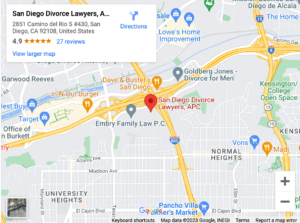
We proudly serve throughout San Diego County. We are located in San Diego, California.
San Diego Divorce Lawyers, APC
2851 Camino del Rio S #430
San Diego, CA 92108
(619) 866-3756