Puja Sachdev | December 5, 2025 | Divorce

California law treats married spouses and unmarried partners very differently. If you live together but aren’t married or registered domestic partners, you don’t get community property rights by default. Still, you may have options through “palimony” (contract-based support) and clear written agreements.
Continue reading to learn more about unmarried cohabitation, palimony, and how to protect your rights.
What Is Palimony in California?
“Palimony” is not a statute. It’s a contract claim between former partners based on promises they made while living together. Since the California Supreme Court’s Marvin v. Marvin decision, courts may enforce express or implied agreements about support or property if they’re lawful and supported by consideration.
There is no automatic support just because you cohabited. Courts look at what the partners actually agreed to, how they behaved during the relationship, and whether enforcing the promise would be fair.
No Common Law Marriage
California does not recognize common law marriage. That means community property rules do not apply to unmarried couples. Unless you are legally married or registered domestic partners, ownership generally follows title and who paid for the asset.
If you want shared ownership, you should put both names on title or create a written agreement. Without that, disputes can become expensive, and the partner without title can be left with little recourse.
When Can a Palimony Claim Work?
Palimony is about enforceable promises—not automatic support.
A claim is more likely to succeed when:
- There is a written cohabitation agreement: A signed contract that sets out support or how to share property
- There is a clear oral promise with consideration: A specific, mutual promise (not vague) that both partners relied on
- There is an implied-in-fact agreement: Conduct shows a deal—such as pooling income, sharing big purchases, or joint investments
- There is more than a sexual relationship: Courts will not enforce agreements based only on sexual services
- There is solid proof of the promise and reliance: Texts, emails, budgets, joint accounts, and witness statements support the claim
Strong, organized evidence often decides these cases, so save communications and financial records early.
Cohabitation Agreements: What to Include
If you live with a partner, consider a written cohabitation agreement that covers:
- Property ownership and title for current and future purchases
- How you’ll share or reimburse living expenses and debts
- Support obligations, if any, after a breakup
- What happens to jointly titled real estate (sale, buyout, timeline)
- Dispute resolution steps (mediation, arbitration)
A clear contract reduces confusion, protects both partners, and minimizes costly disputes if the relationship ends.
Time Limits and Proof
Deadlines matter. In California, most written contract claims have a four-year statute of limitations, while most oral contract claims have two years. If you’re relying on a promise, do not wait to gather proof.
Save messages, bank records, and receipts. If you purchased property together, keep a paper trail of contributions. These materials help show what you both intended and what each of you contributed.
Children, Support, and Housing
Palimony and property are separate from rights involving children. Child support and legal/physical child custody are decided under California’s family law rules based on a child’s best interests and each parent’s income.
If you share a rental, check your lease for co-tenancy or subtenancy rules. For jointly owned homes, consider a written exit plan (buyout formula, appraisal method, and deadlines) to avoid a forced partition action.
Practical Steps To Protect Yourself
Take simple steps during the relationship to avoid conflict later:
- Put important assets in joint title, if truly shared
- Keep a written budget and contribution log
- Sign a cohabitation agreement before buying a home together
- Avoid commingling business interests without a separate agreement
- Revisit your plan if your roles change (e.g., one partner stops working)
Thoughtful planning now can save time, money, and stress later.
Contact the San Diego Divorce Lawyers at San Diego Divorce Lawyers, APC for Help Today
Questions about palimony or cohabitation agreements? At San Diego Divorce Lawyers, APC, our San Diego divorce attorneys guide unmarried partners through contract options, asset planning, and breakup strategies that preserve rights and reduce friction.
We offer complimentary case evaluations to review your goals and evidence, explain likely outcomes, and map the next steps. Reach out to us to discuss a clear, legally sound plan tailored to your situation.
Contact our experienced San Diego divorce lawyers at San Diego Divorce Lawyers, APC, today for legal assistance. Contact us at (619) 866-3756 to schedule a complimentary case evaluation.
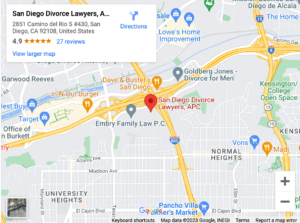
We proudly serve throughout San Diego County. We are located in San Diego, California.
San Diego Divorce Lawyers, APC
2851 Camino del Rio S #430
San Diego, CA 92108
(619) 866-3756