Puja Sachdev | January 6, 2026 | Family Law

Family law cases often involve emotionally charged disputes. Due to the high stakes involved (such as child custody and property), courts issue orders that require compliance from all parties. When one party fails to comply with a court order, the consequences can be serious.
In family law, contempt proceedings are a key enforcement tool.
Overview of Contempt of Court
Contempt of court refers to behavior that disobeys or undermines the authority of a court. In family law, contempt most commonly arises when a party violates a court order related to divorce or a child custody/support order.
There are generally two types of contempt: civil contempt and criminal contempt. Civil contempt is remedial in nature and is intended to ensure compliance with a court order. For example, if a parent refuses to pay court-ordered child support, the court may find that parent in civil contempt until payments are made.
Criminal contempt, on the other hand, aims to punish willful disregard for the court’s authority, such as repeatedly ignoring court orders or disrupting court proceedings.
To establish contempt in a family law case, the court typically requires proof that the accused party knowingly violated a court order. Accidental violations may not rise to the level of contempt.
Penalties for Contempt Charges
The penalties for contempt of court in family law vary depending on the severity of the violation and whether the contempt is civil or criminal. Courts have broad discretion to impose sanctions.
Common penalties include fines, payment of the opposing party’s attorney’s fees, wage garnishment, or mandatory compliance deadlines. In child support cases, courts may order income withholding to ensure timely payment of child support. In more serious situations, a judge may impose jail time.
Incarceration arising from civil contempt is typically conditional, meaning the person can be released once they comply with the court order (e.g., paying overdue support). Because criminal contempt is a punitive offense, courts generally apply heightened procedural safeguards.
Repeated violations may result in remedies such as make-up parenting time, and in some cases, may support a later custody or visitation modification where the legal standard is met.
How a Contempt of Court Charge Can Affect Your Family Law Case
A contempt of court charge can significantly impact the outcome of a family law case. Judges closely consider a party’s willingness to follow court orders when making decisions about custody/visitation and support. A finding of contempt may harm a parent’s credibility and raise concerns about their ability to act in the best interest of the child.
In custody disputes, repeated contempt findings can lead to reduced parenting time or even a change in primary custody.
Beyond immediate penalties, contempt charges can prolong litigation, increase costs, and escalate conflict between parties. They may also create a documented history of misconduct that affects future court proceedings.
If a party is unable to comply with an order due to legitimate reasons, contempt may be avoidable. Here, the appropriate course of action is to request a modification from the court. You should not ignore the order. Courts are generally more receptive to modification requests than to willful disobedience.
Contact an Experienced San Diego Family Law Attorney at San Diego Divorce Lawyers, APC for a Free Case Evaluation
Contempt of court in family law helps enforce court orders and maintain respect for the judicial system. Whether related to child support, custody, or other family law obligations, contempt charges can carry serious legal and personal consequences.
If you are facing contempt charges or need to request a modification to a court order, you have options. Contact an experienced San Diego family law attorney for help understanding your rights. San Diego Divorce Lawyers, APC, offers a complimentary case evaluation.
Contact our experienced San Diego divorce lawyers at San Diego Divorce Lawyers, APC, today for legal assistance. Contact us at (619) 866-3756 to schedule a complimentary case evaluation.
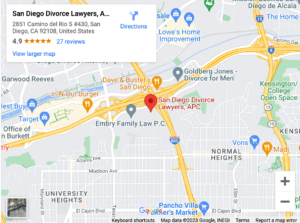
We proudly serve throughout San Diego County. We are located in San Diego, California.
San Diego Divorce Lawyers, APC
2851 Camino del Rio S #430
San Diego, CA 92108
(619) 866-3756